Parkinson’s Physiotherapist Gold Coast: Mobile Neurological Physiotherapy
Mobile Parkinson’s physiotherapy across the Gold Coast. We come to you at home, timing sessions around your medication to work on walking, balance, freezing of gait and falls.
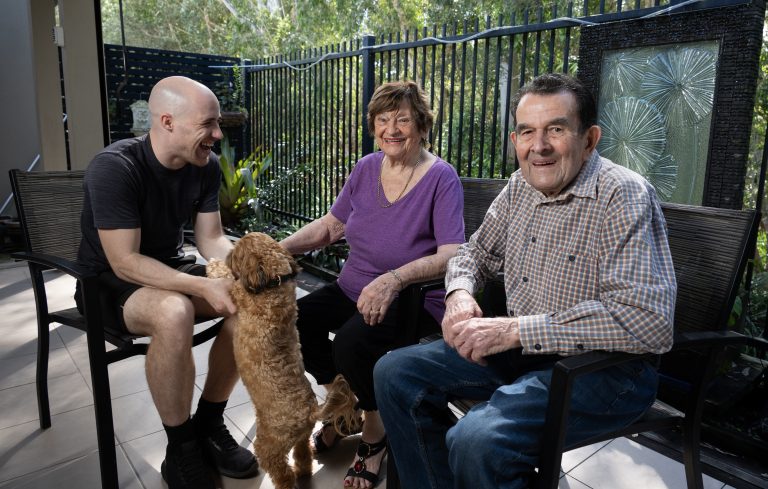
Move with confidence
Stay steady and independent
- Walk with bigger, safer steps
- Feel like yourself again
- Get back on your feet
- Reduce your falls risk
- Reduce pain
- Build confidence at home

Improve your recovery and get back to what you love!

Evidence-Based Techniques
Our rehabilitation programs are based on the latest evidence and best practices in physiotherapy and rehabilitation. We utilise a variety of techniques and modalities to address your specific needs.rn

Manual Therapy
Hands-on techniques such as massage, joint mobilisation, and stretching to reduce pain, improve flexibility, and restore function.

Functional Training Exercise Prescription
Customized exercise programs designed to improve strength, balance, and mobility, tailored to your current level of fitness and ability. Activities and exercises that mimic real-life movements to help you regain the skills and abilities needed for everyday activities.

Education and Support
We provide education and support to help you better understand your condition, manage symptoms, and prevent future injuries, empowering you to take control of your recovery journey.rn
GM Physiotherapy is a mobile neuro physio team that brings Parkinson’s care to your door across the Gold Coast. We visit you at home, in your retirement village or in your aged care room, so there is no driving, no parking and no waiting room on a day when your medication is wearing off.
Whether you are newly diagnosed or have lived with Parkinson’s disease for many years, our goal is the same: to help you move better, move more safely and maintain independence for as long as possible.
At a glance
- We come to you, anywhere on the Gold Coast, seven days a week.
- Sessions can be timed around your medication, so you work when you move best.
- Exercise probably reduces falls in Parkinson’s by around 26 per cent.
- NDIS, Support at Home, Medicare, DVA and private funding all accepted.
Is Physiotherapy Good for Parkinson’s Disease?
Yes. Exercise and physio are among the best-supported non-drug treatments for people with Parkinson’s disease. A 2024 Cochrane review pooled 154 randomised trials with 7,837 participants and found that almost every form of structured exercise helped. Gait, balance and functional training had a moderate beneficial effect on motor symptoms, and aqua-based training had a large beneficial effect on quality of life. The authors concluded that exercise itself is what matters most, and the exact type may be secondary.
Falls are one of the biggest concerns for people living with Parkinson’s disease and their families. A 2022 Cochrane review of falls prevention in Parkinson’s found that exercise probably reduces the number of falls by around 26 per cent, rated moderate certainty. That is why balance and falls work sits at the centre of our programmes.
26%
fewer falls with regular exercise, according to a 2022 Cochrane review of falls prevention in Parkinson’s.
Therapy and exercise do not cure Parkinson’s, and we will never claim they do. Parkinson’s is a long-term condition. What good treatment can do is help you stay stronger, steadier and more confident, and slow the loss of function that makes everyday activities harder.
What Does a Parkinson’s Physiotherapist Do?
A Parkinson’s physiotherapist is a physiotherapist with a particular interest in neurological conditions and movement disorders. The job is to understand how Parkinson’s affects your movement, then build targeted exercise and practical strategies around your goals. Common areas of focus include:
Walking and gait
Shuffling, short steps and reduced arm swing are common. We use amplitude training and task-specific practice to help you take bigger, more confident steps.
Freezing of gait
Many people describe their feet feeling glued to the floor in doorways or when turning. Visual, auditory and attentional cueing strategies can help you get moving again.
Balance and falls prevention
Including safe turning, stepping reactions and how to get up off the floor.
Stiffness and posture
Rigidity and a stooped posture can cause pain and affect breathing. Mobility work and strength training help counter this.
Slowness of movement
Bradykinesia makes getting out of a chair, turning in bed or getting out of a car harder. We break these tasks down and practise them where you actually do them.
Dual tasking
Walking while talking or carrying a cup is often harder with Parkinson’s. We train it deliberately.
Tremor management
Exercise cannot switch off a tremor, but positioning, strategies and strength can reduce its impact on daily tasks.
Fitness and strength
Aerobic and resistance exercise are recommended at every stage of the condition.
Every programme is individualised. Two people with the same diagnosis can have very different symptoms, so we do not hand out generic exercise sheets.
What Is Neurological Physiotherapy and Neuro Rehabilitation?
Neurological physiotherapy, often shortened to neuro physiotherapy, is treatment for people whose movement is affected by a neurological condition or neurological injury involving the brain, spinal cord or nerves. As well as Parkinson’s, a neurological physiotherapist commonly sees people after stroke, acquired brain injury and spinal cord injuries, and people living with multiple sclerosis or another progressive neurological disorder.
The approach is built on neuroplasticity, the brain’s ability to adapt and form new connections in response to repeated, challenging practice. For people with Parkinson’s, that means consistent therapy works best: regular, high-effort sessions with plenty of home practice in between. Our director, Grant Muir, has a background that includes hospital neuro-rehabilitation, and neurological and post-stroke rehabilitation is one of his stated clinical interests. You can read more on our stroke rehabilitation page.
Why Mobile Parkinson’s Care Works Well for You and Your Carer
Home visits are not an add-on for us. They are the whole model, and for Parkinson’s there are strong practical reasons for it.
- We can time sessions around your medication. Many people with Parkinson’s have “on” and “off” periods through the day. Because we come to you, we can book therapy sessions for the part of the day when you move best, or deliberately practise strategies during harder periods.
- Freezing happens in real places. Doorways, narrow hallways, the gap between the bed and the ensuite. We work on those exact spots rather than a clinic corridor.
- Falls risk is visible. We see the rug, the step, the low couch and the poor lighting, and we can suggest practical changes.
- Your carer can join in. A partner, family member or support worker can learn the cues and exercises so therapy continues between visits, and many carers tell us they feel empowered once they know what to do.
- No travel fatigue. Getting to a clinic can use up the energy you would rather spend on exercise.
Our Parkinson’s Physiotherapy Services
Our physiotherapy services are tailored to your stage, your symptoms and what you want to be able to do. They include:
- A comprehensive 90-minute initial assessment
- Tailored exercise programs using large-amplitude, high-effort movement principles, the same principles that underpin well-known Parkinson’s programmes such as LSVT BIG and PD Warrior
- Gait retraining and cueing strategies for freezing
- Balance, strength and falls prevention programmes
- Transfer practice for bed, chair, toilet and car
- Walking aid assessment and prescription
- Posture, flexibility and pain management, including hands-on treatment where appropriate
- Carer education and a written home practice programme
- Support before and after procedures such as deep brain stimulation or focused ultrasound, working alongside your neurologist
- Osteopathy, which some people with Parkinson’s find helpful for persistent stiffness and pain
Newly Diagnosed With Parkinson’s
You do not need to wait until symptoms are affecting your life before seeing a physio. Starting early lets us record a baseline, build fitness and strength while you are well, and set up exercise habits you can keep for years. Guidelines encourage people with Parkinson’s to see a physiotherapist soon after diagnosis rather than only once problems appear.
Consistent Therapy as Parkinson’s Progresses
As Parkinson’s progresses, the focus usually shifts towards falls prevention, transfers, carer support and keeping you as independent as possible at home. After a fall or a hospital stay, the aim may be to regain independence you have lost. We adjust the programme as your needs change, so our physiotherapy support stays useful and continues to support independence rather than becoming generic.
What to Expect During a Parkinson’s Physiotherapy Appointment
Your first visit is a 90-minute assessment in your own home. We start by talking about what matters to you, whether that is walking to the beach, getting in and out of the car without help, or feeling safe in the shower. We then assess your walking, balance, strength, flexibility, transfers and falls risk, often using standard outcome measures such as timed walking and balance tests so progress can be tracked objectively.
From there we agree measurable goals, how often we will visit, and what you will practise between sessions. Follow-up treatment sessions are usually 60 minutes. We write to your general practitioner and neurologist where helpful, so everyone in your care team knows what is happening.
Working With Your Allied Health and Aged Care Team
Parkinson’s care works best with a multidisciplinary team of health professionals. We regularly work alongside your GP, neurologist, Parkinson’s nurse, occupational therapy, speech pathology, exercise physiology and aged care providers, so your physiotherapy and allied health care pulls in one direction.
An occupational therapist generally focuses on daily tasks and equipment for the home, and an exercise physiologist can help with longer-term fitness, including group classes. A physio concentrates on movement itself: walking, balance, strength and falls. Where other allied health services or therapy services would help you more, we will say so and help arrange the referral. Some people also combine home sessions with hydrotherapy or a community exercise class, which the evidence supports.
Parkinson’s Queensland runs support groups and activities across the state, and its helpline on 1800 644 189 is a good source of health support and information. The Gold Coast University Hospital neurology service also offers magnetic resonance-guided focused ultrasound for some people with tremor, and we can support your mobility before and after treatment.
Funding and Referral Options for Parkinson’s Physiotherapy
We publish our fees openly, so you know the cost before you book. Private sessions are $200 for the 90-minute initial assessment and $165 for a 60-minute treatment session. Full details are on our fees page. The main funding routes are:
- NDIS. GM Physiotherapy is a registered NDIS provider. Parkinson’s is recognised by the scheme, and people who apply before age 65 may be eligible. Physiotherapy is usually funded under capacity building supports, and we work with self-managed, plan-managed and agency-managed participants. See our NDIS physiotherapy page.
- Support at Home. Under the Support at Home program, physiotherapy is classed as a clinical support, so eligible older people pay no contribution towards it. We see clients under My Aged Care (Support at Home) through their registered provider.
- Medicare. A GP Chronic Condition Management Plan gives up to five subsidised allied health services per calendar year. You will need a referral from your doctor.
- DVA. Gold Card holders, and White Card holders with an accepted condition, can access treatment with a referral from their doctor.
- Private health insurance. Rebates depend on your level of extras cover.
- Private. No referral, no waiting list and no eligibility test.
Gold Coast Physio Home Visits: Where We Provide Parkinson’s Care
We provide mobile physiotherapy in Gold Coast homes, retirement villages and aged care residences across QLD’s Gold Coast, including Runaway Bay, Hope Island, Helensvale, Southport, Labrador, Nerang, Ashmore, Robina, Broadbeach, Burleigh Heads, Varsity Lakes, Palm Beach, Currumbin and Coolangatta, with Ormeau and the northern corridor by arrangement. If you live over the border in Tweed Heads or your suburb is not listed, please ask. As a Gold Coast physio team that only works in people’s homes, we plan our rounds to keep visits reliable.
Frequently Asked Questions
Can physiotherapy help with Parkinson’s disease?
Yes. Large reviews show that structured exercise improves motor symptoms and quality of life, and exercise probably reduces falls by around a quarter. It does not stop Parkinson’s, but it can help you move better and stay independent for longer.
What is the 5:2:1 rule in Parkinson’s?
The 5:2:1 rule is a screening guide used by doctors to flag advanced Parkinson’s that may need a medication review or device-aided therapy. It refers to taking levodopa five or more times a day, having two or more hours of “off” time a day, or one or more hours of troublesome dyskinesia. It is not an exercise rule. If it sounds familiar, speak to your neurologist.
What activities are good for seniors with Parkinson’s disease?
Walking, strength training, balance work, dance, tai chi, cycling and water-based exercise all have supporting evidence. The best activity is one you enjoy and will keep doing, ideally several times a week.
Do I need a referral to see a neurological physiotherapist?
Not for private, NDIS or Support at Home funded sessions. Medicare and DVA both require a GP referral.
How do home visits work for someone with Parkinson’s?
We bring everything needed for assessment and treatment. Sessions take place in your home or residence, ideally at a time when your medication is working well, and carers are welcome to join.
Can I use NDIS funding for Parkinson’s physiotherapy on the Gold Coast?
Yes, if you are a participant with physiotherapy in your plan. We are a registered provider.
Why is Parkinson’s becoming more common?
Parkinson’s is the fastest-growing neurological condition in the world. An ageing population is the main driver, along with longer survival after diagnosis and better recognition of the condition.
Book a Parkinson’s Physiotherapist on the Gold Coast
If you or someone you care for is living with Parkinson’s, we are happy to talk it through with no obligation, including which funding route suits you. Our experienced physiotherapists visit seven days a week between 8am and 6pm by appointment.
Call GM Physiotherapy on 0478 941 638 or send us a message, and we will arrange a home visit that suits you.
